
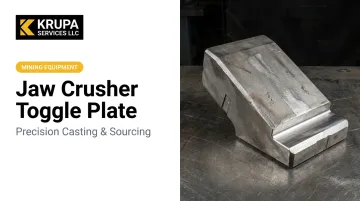
This guide covers everything a plant engineer or maintenance manager needs: what the toggle plate is, how it functions within the crusher's mechanical chain, which design and material suits your crushing conditions, and how to catch wear before it becomes an emergency shutdown.
Key Takeaways
- The toggle plate transmits crushing force, acts as a sacrificial safety fuse, and controls discharge opening size
- Two structural designs exist — assembled (modular) and integral (single-piece) — each suited to different crusher types
- High manganese steel and high chromium cast iron are the standard material choices; selection depends on feed abrasiveness and expected failure mode
- Visible cracks, uneven jaw movement, excessive vibration, and widening discharge gap signal replacement is needed
- Replacement requires full lockout/tagout, seat cleaning, parallel alignment, and CSS verification before restarting
What Is a Jaw Crusher Toggle Plate?
The toggle plate is a precision-cast metal component seated at the base of the movable jaw assembly. It bridges the pitman (driven by the eccentric shaft) and the swing jaw, sitting in machined contact seats at each end. Depending on the manufacturer, you'll also see it called a "toggle block" or "elbow plate" (all referring to the same part).
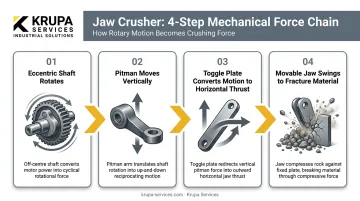
Its position in the mechanical chain looks like this:
- The eccentric shaft rotates
- The pitman moves vertically
- The toggle plate converts that vertical motion into horizontal thrust
- The movable jaw swings against the fixed jaw to compress and fracture material
Despite its relatively simple shape, the toggle plate carries three distinct operational responsibilities at once:
- Force transmission — transfers pitman thrust directly to the swing jaw
- Safety device — designed to fracture under overload, protecting costlier components
- Adjustment mechanism — its geometry sets the jaw's rest position and discharge opening
Small dimensional errors at the toggle seat contact areas create uneven loading that accelerates wear across the entire assembly. Geometry here is not a detail — it's the difference between predictable service life and premature failure.
CSS Adjustment and Toggle Plate Length
The closed-side setting (CSS) — the minimum gap between jaw plates at the discharge end — is directly influenced by toggle plate geometry. Many jaw crusher designs use a shim system behind the toggle seat to adjust CSS: modifying shim stack height repositions the toggle seat, which changes the jaw's rest position and therefore the discharge opening. Check your OEM manual, as adjustment direction varies by crusher model.
In modern hydraulic jaw crushers, cylinders handle CSS adjustment automatically. The toggle plate's force-transmission and safety roles remain unchanged in these designs.
Key Functions of the Toggle Plate
Force Transmission
The toggle plate is the final mechanical link in the crushing force path. Every compressive load generated when rock is fractured travels from the movable jaw, through the toggle plate, and into the crusher frame via the toggle seats.
The forces involved are substantial — mid-to-large jaw crushers operate under cyclic compressive loads that stress the toggle interface with each rotation of the eccentric shaft. The plate must transmit these loads without deflection or fatigue cracking across millions of cycles.
Toggle plate angle also affects the mechanical advantage of the crushing stroke. A steeper angle increases the horizontal force component delivered to the jaw, which is why OEMs calculate toggle geometry carefully for each crusher model.
Safety Device (Mechanical Fuse)
This is the function most operators understand conceptually but underestimate in practice. The toggle plate is intentionally designed to fail first. OEMs calculate its cross-sectional area so that when uncrushable material — tramp metal, steel rebar, oversized non-breakable objects — enters the crushing chamber, the toggle plate fractures before the crusher frame, eccentric shaft, or main bearings absorb the overload.
As McLanahan describes in their jaw crusher documentation, the toggle plate is a safety mechanism designed to bend or break when uncrushable material enters, protecting far more expensive components downstream. The failure hierarchy matters:
- Toggle plate fractures → planned, low-cost replacement
- Crusher frame cracks → weeks of downtime, major repair cost
- Eccentric shaft or main bearings fail → potential full rebuild
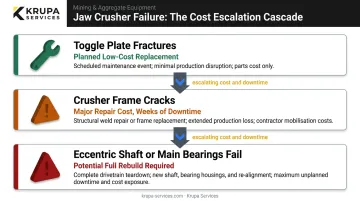
A toggle plate replacement is a manageable maintenance event. A cracked crusher frame or failed eccentric shaft is neither.
Discharge Opening Control
Toggle plate length sets the jaw's mechanical stop position, directly controlling the closed-side setting (CSS). As jaw plates, toggle seats, and the pitman toggle seat wear over time, operators compensate by adjusting the shim stack — adding or removing shims to maintain target product size.
This makes the toggle plate and its seating surfaces a functional part of product quality control, not just a structural component.
Single-Toggle vs. Double-Toggle Behavior
The toggle arrangement differs significantly between crusher types:
| Feature | Single-Toggle Crusher | Double-Toggle Crusher |
|---|---|---|
| Toggle plates | One | Two (front and rear) |
| Jaw motion | Elliptical (compressive + rubbing) | Near-pure reciprocating |
| Wear on jaw dies | Higher due to rubbing component | Lower under abrasive conditions |
| Construction | Lighter, simpler, widely used | Heavier, older-style or special duty |
| Throughput tendency | Higher throughput, lower capital cost | Suited for harder, more abrasive rock |
According to the Metso Basics in Minerals Processing Handbook, the double-toggle design produces a motion path that minimizes the rubbing component at the jaw face — making it the preferred choice for very hard, highly abrasive feeds where jaw die wear is the primary concern. Single-toggle designs dominate modern aggregate and mining installations due to their simpler construction and higher throughput capability.
In double-toggle setups, load distributes across two plates — each plate sees less peak stress, which typically extends individual plate service life compared to the single plate in a single-toggle machine. That said, you're managing two replacement intervals instead of one.
Lubrication at the Toggle Seat Interface
The toggle plate-to-seat contact operates under near-dry friction conditions with abrasive fines present. OEM literature from Terex, Sandvik, and others specifies lubrication provisions for toggle seat systems, including scheduled greasing intervals. Neglecting these intervals allows abrasive particles to act as a grinding medium between the toggle plate ends and their seats, accelerating wear at the contact surfaces. Follow your crusher's OEM manual for grease type and interval — it varies by model.
Toggle Plate Types: Assembled vs. Integral
Assembled (Modular) Toggle Plates
Assembled toggle plates consist of a central body with two replaceable toggle ends that bolt onto each end. Only the ends wear significantly in service; the central body typically outlasts multiple sets of ends. This makes the design cost-effective for large crushers where the full component is heavy and expensive to replace entirely.
Two sub-types exist within this category:
- Rolling type — cylindrical toggle ends roll on flat seats, achieving near-pure rolling motion during operation, which reduces friction and wear at the contact interface
- Sliding type — metal-on-metal sliding under high load; simpler but accelerates surface degradation at the contact areas over time
Assembled plates are common in simple pendulum (single-toggle) jaw crushers where the toggle plate sees high load cycling and the ends wear faster than the body.
Integral (Single-Piece) Toggle Plates
Integral toggle plates are unified single-piece castings with no replaceable sections. They're lighter, simpler to install and remove, and the standard design for compound pendulum jaw crushers.
The trade-off is simple: when contact surfaces wear out, the entire plate must be replaced rather than just the ends. For smaller crushers — where the component is lighter and less costly — that's a reasonable exchange for the reduced complexity.
A quick comparison of the two types:
| Attribute | Assembled (Modular) | Integral (Single-Piece) |
|---|---|---|
| Construction | Body + replaceable ends | Single casting |
| Wear replacement | Ends only | Full plate |
| Typical application | Simple pendulum (single-toggle) | Compound pendulum (double-toggle) |
| Best for | Large, heavy crushers | Smaller, lighter crushers |
Toggle Plate Materials: How to Choose the Right Grade
High Manganese Steel (Mn13 and Mn18)
Manganese steel's key property is work hardening. The as-cast surface starts at approximately 200 HB, but under repeated compressive loading, the surface progressively hardens — reaching well above 500 HB in service conditions, according to metallurgical data on Hadfield-type austenitic manganese steel.
- Mn13 (13% manganese): general-purpose crushing, moderate abrasion, good impact toughness
- Mn18 (18% manganese): preferred for higher-impact applications where the additional manganese content sustains the work-hardening response under more severe loading
Both grades are covered under ASTM A128/A128M for austenitic manganese steel castings.
High Chromium Cast Iron (Cr12–Cr26)
High chromium cast iron disperses hard chromium carbide particles throughout the iron matrix, delivering hardness significantly above what manganese steel achieves. The trade-off: higher hardness means greater brittleness. Proper heat treatment during manufacturing is critical to balance hardness against fracture toughness. The relevant standard is ASTM A532/A532M for abrasion-resistant cast irons.
The application fit is materials with high Bond Abrasion Index values — granite (Ai ~0.46), sandstone (~0.60), quartzite (~0.79). For these feeds, abrasion resistance matters more than impact toughness, which is where high chromium iron earns its premium.
Practical Selection Framework
| Factor | Consider Mn13/Mn18 | Consider Cr12–Cr26 |
|---|---|---|
| Primary failure mode | Impact fracture | Abrasive surface wear |
| Feed material | Softer rock, mixed feeds | Granite, basalt, silica-rich aggregates |
| Operating priority | Resilience against tramp metal events | Maximum wear life between planned stops |
| Manufacturing requirement | Standard heat treatment | Controlled heat treatment essential |
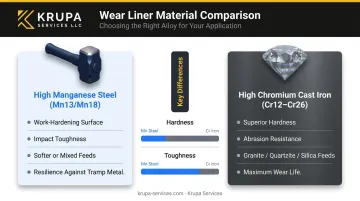
The selection table above guides material choice, but the grade alone doesn't determine total cost. A premium plate that lasts significantly longer between replacements can offset its higher upfront cost when you factor in labor per swap, crusher downtime during replacement, and the risk of an unplanned failure mid-shift.
Material grade and dimensional execution work together. Tolerances at the toggle seat contact areas, surface finish, and metallurgical consistency through controlled heat treatment all determine how evenly force distributes across the plate and how long it lasts in service. Krupa Services produces toggle plates through CNC machining, fabrication, and casting processes built to the dimensional and material specifications that demanding crushing environments require.
Signs of Wear and When to Replace
Key Warning Signs
Watch for these indicators during routine checks:
- Visible surface cracks or fracture lines — replace immediately; do not continue operating
- Uneven or asymmetric jaw movement — suggests misalignment at the toggle seats
- Vibration beyond normal operating levels — can indicate toggle plate looseness or contact surface degradation
- Audible metallic rattling from the toggle assembly — the plate may be moving excessively in its seats
- Gradual CSS increase despite shim adjustments — indicates loss of toggle plate thickness over time
The distinction between worn and failed matters operationally. A worn plate still functions but should be scheduled for replacement at the next planned maintenance window. A failed plate — one cracked through or fully fractured — requires immediate shutdown.
Catching wear early prevents cascading damage to toggle seats, the pitman, and crusher bearings. All of those components carry higher replacement costs and longer procurement lead times than the toggle plate itself.
Inspection Schedule
| Frequency | What to Check |
|---|---|
| Daily | Listen for abnormal noise; observe jaw motion symmetry |
| Weekly | Visual inspection of toggle ends and seats for scoring or galling |
| Monthly | Lubrication reapplication; spring tension verification |
| Quarterly | Dimensional inspection of toggle plate thickness and seat surfaces |
This schedule informs the replacement decision — but there is no universal interval. Replacement timing varies too widely by material grade, feed abrasiveness, and operating hours. Condition-based inspection is more reliable than fixed time intervals to determine when replacement is needed.
How to Replace a Jaw Crusher Toggle Plate
Pre-Replacement Safety
No toggle plate work on a running or partially powered machine. Before starting:
- Isolate and lock out/tag out per OSHA 29 CFR 1910.147 and applicable MSHA regulations (30 CFR 56.14105 for surface mines)
- Confirm the flywheel has fully stopped and all stored energy is released
- Gather the correct replacement plate, tools, and consumables before beginning
Replacement Sequence
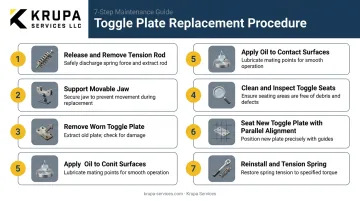
- Release and remove the tension rod and spring assembly
- Support the movable jaw to prevent uncontrolled movement once the toggle plate is free
- Remove the worn toggle plate from the toggle seats
- Clean and inspect both toggle seats and the pitman contact surface for wear, scoring, or deformation — address any issues before installing the new plate
- Apply a thin layer of appropriate machine oil to contact surfaces
- Seat the new toggle plate, verifying parallel alignment between toggle seat surfaces; misalignment creates uneven loading and accelerates wear
- Reinstall and tension the tension rod spring per the crusher manufacturer's specification
Post-Installation Verification
- Run the crusher empty at reduced speed; listen for abnormal noise or vibration
- Verify CSS matches the required setting using your OEM's specified measurement method (lead plug or equivalent)
- Only then proceed to full production feeding
Once your crusher is back in production, it's worth having a qualified replacement plate on hand before the next scheduled inspection. Krupa Services sources toggle plates through a network of 100+ vetted manufacturers, matched to your crusher's dimensional specifications and material requirements. Reach the team at support@krupa-services.com or +1 720-984-0932 to discuss your application.
Frequently Asked Questions
What is the function of toggle plate in jaw crusher?
The toggle plate transmits crushing force from the pitman to the movable jaw — that's its primary mechanical role. It also functions as a built-in safety fuse, fracturing before the crusher frame or eccentric shaft sustain damage from uncrushable material. Discharge opening adjustment is made by changing plate length or adding shims at the toggle seat.
What is the difference between single toggle and double toggle jaw crusher?
A single-toggle crusher uses one toggle plate and an overhead eccentric shaft. The resulting elliptical jaw motion delivers higher throughput at lower capital cost, though jaw die wear runs higher. A double-toggle crusher uses two toggle plates and a separate eccentric driving the pitman, producing near-pure compressive motion — better suited for harder, more abrasive rock, but at heavier construction and higher capital cost.
What material is a jaw crusher toggle plate made of?
Toggle plates are most commonly made from high manganese steel (Mn13 or Mn18) for its work-hardening properties under impact loading, or high chromium cast iron (Cr12–Cr26) for superior abrasion resistance in demanding applications. Choice depends on feed material abrasiveness and whether the primary wear mode is impact or abrasion.
How often should a jaw crusher toggle plate be replaced?
Replacement intervals typically range from a few hundred to several thousand operating hours depending on material grade and feed abrasiveness. Weekly visual checks and monthly dimensional measurements are more reliable triggers for replacement than any fixed calendar schedule.
What happens if a toggle plate breaks in a jaw crusher?
A broken toggle plate immediately stops crushing action as the movable jaw loses its drive linkage — this is by design. The plate fractures to protect the crusher frame, eccentric shaft, and bearings from catastrophic damage. Shut down the crusher, remove the broken plate, and install a correctly specified replacement before resuming operation.
What causes excessive toggle plate wear?
Common causes include:
- Insufficient or absent lubrication at the toggle-seat interface, creating dry abrasive friction
- Toggle seat misalignment concentrating load unevenly across the plate
- Oversized or excessively hard feed material exceeding the crusher's design parameters
- Incorrect spring tension allowing the plate to shift excessively during operation