This guide clarifies the U.S. automotive parts supply landscape for OEM procurement teams. You'll find current market data, the Tier 1/2/3 classification system explained with concrete examples, profiles of the top U.S. manufacturers serving OEMs across drivetrain, electrical, and chassis categories, and a practical evaluation framework rooted in process fit, IATF 16949 compliance, and program-length repeatability—not brand recognition.
Key Takeaways
- The U.S. automotive parts manufacturing market hit $647.15 billion in 2024 and is projected to reach $754.5 billion by 2033 at 1.72% CAGR
- OEMs should evaluate suppliers on manufacturing process fit, IATF 16949 certification, and secondary operation scope—not quoted price or company size alone
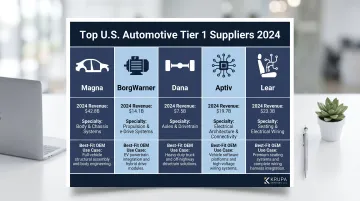
- Leading U.S. suppliers cover distinct specialties: Magna (body/chassis), BorgWarner (turbochargers/e-drives), Dana (axles), Aptiv (electrical), Lear (seating/wiring)
- Tier 1 suppliers deliver systems directly to OEMs; Tier 2 suppliers produce sub-components for Tier 1s; Tier 3 suppliers provide raw materials
- Validating tooling ownership, audit readiness, and supply continuity through direct references separates reliable partners from well-marketed ones
U.S. Automotive OEM Parts Manufacturing: Market Overview
OEM automotive parts manufacturing in the U.S. context refers to components produced to automaker specifications for original vehicle assembly—distinct from aftermarket replacement parts. Domestic sourcing is regaining priority among vehicle manufacturers due to three converging forces:
- USMCA rules-of-origin incentives rewarding domestic content in assembled vehicles
- Inflation Reduction Act requirements tying EV tax credits to North American battery supply chains
- Supply chain disruptions that revealed how costly offshore dependencies can be when production lines stop
The United States auto parts manufacturing market was valued at USD 647.15 billion in 2024 and is projected to grow to USD 754.5 billion by 2033, reflecting a CAGR of 1.72% (Research and Markets, December 2025). Key growth drivers include increased U.S. vehicle production (approximately 10.58 million units as of mid-2025), rising demand for electric and hybrid vehicle components (battery systems, lightweight materials), and technological advancements in automation and additive manufacturing.
U.S. automotive investment surged from $27.9 billion in 2019 to $87.8 billion in 2023, then moderated to $34.1 billion in 2024 (USITC, July 2025). Parts production has recovered and now exceeds pre-pandemic 2019 levels. According to the USITC, USMCA rules of origin have measurably lifted U.S. supplier performance across:
- Employment and headcount
- Production volumes and revenue
- Capital expenditures and profitability
The Inflation Reduction Act has driven even stronger gains in battery and EV-related segments.
Understanding the tier classification system is the right starting point—it determines how suppliers interact with automakers and shapes every sourcing decision that follows.
Understanding the Automotive Supply Chain: Tier 1, Tier 2, and Tier 3
The automotive supply chain operates through a three-tier hierarchy that defines supplier roles, integration responsibility, and contractual relationships.
| Tier | Role | Contracts With | Manufacturing Examples | Accountability |
|---|---|---|---|---|
| Tier 1 | Delivers complete systems or modules to OEM assembly lines | Directly with the OEM | Fully assembled seat systems (frame, foam, covers, electronics); validated transmission gearbox units ready for bolt-in installation | System-level engineering; manages own sub-supplier network |
| Tier 2 | Produces sub-components, specialized parts, or software for Tier 1 suppliers | Tier 1 suppliers (not OEMs) | Seat frame rails for a Tier 1 seating supplier; sensor modules for a Tier 1 ADAS integrator | Process specialization — casting, forging, injection molding — not complete system design |
| Tier 3 | Supplies raw materials and standard parts to Tier 2 suppliers | Tier 2 suppliers | Sheet metal to stamping houses; bolts and clips to component fabricators; polymer feedstock to injection molders | Commodity markets with standardized products |
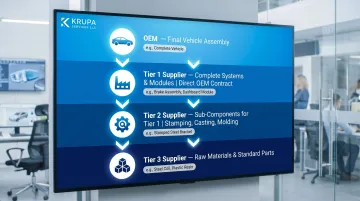
The key distinction between OEM and Tier 1 is integration responsibility: OEMs design and assemble the final vehicle, while Tier 1 suppliers own the complete system design and interface directly with your vehicle architecture. This boundary determines contract structure, warranty responsibility, and the engineering support scope you can expect from a supplier.
The manufacturers profiled in this guide are primarily Tier 1 suppliers or precision manufacturers with direct OEM supply relationships — they contract with automakers and carry system-level accountability for what they deliver.
Top Automotive Parts Manufacturers in USA for OEMs
The following manufacturers were selected based on U.S. manufacturing presence, OEM supply track record, product category coverage, IATF 16949 or ISO 9001 certification status, and relevance to diverse vehicle programs. Rankings draw from 2024 global OE sales data published by Automotive News.
Magna International
Magna International is one of the world's largest automotive Tier 1 suppliers with extensive U.S. manufacturing operations covering body and chassis systems, exterior components, seating structures, and drivetrain modules. The company reported $42.8 billion in global sales for 2024, with 48% from North America (approximately $20.6 billion) (Magna 2024 Annual Report). Magna ranks #3 globally among OE suppliers and operates 327 manufacturing facilities across 28 countries, serving 58 OEMs worldwide.
Magna's core value for OEMs is breadth: it supplies mechanical systems across multiple vehicle platforms, letting OEMs consolidate sourcing for body structures, powertrain components, and complete vehicle manufacturing through a single supplier relationship. The company states its products appear on "two out of every three vehicles launched around the world" and has produced more than 4 million complete vehicles for 13 OEMs covering 39 models.
On quality systems, Magna confirms that "without IATF 16949 certification, a company is virtually ineligible as a supplier for serial production in the automotive industry" (Magna quality page).
| Manufacturing Focus | Metal forming, casting, body systems, drivetrain modules, complete mechanical assemblies |
|---|---|
| Key OEM Products | Structural body parts, seating structures, exterior systems, chassis components, battery enclosures |
| Best-Fit OEM Use Cases | Programs requiring integrated mechanical systems across multiple vehicle lines at high volume |
BorgWarner
BorgWarner is a U.S.-headquartered propulsion technology manufacturer with domestic facilities serving both conventional and electrified vehicle platforms. Headquartered in Auburn Hills, Michigan, the company reported $14.086 billion in net sales for 2024. BorgWarner operates at the intersection of combustion and electric propulsion, manufacturing turbochargers for internal combustion engines alongside e-motors and 800-volt integrated drive modules for battery electric vehicles (BorgWarner Q4 2024 results).
That mix makes BorgWarner a practical supplier for OEMs running both combustion and electric platforms simultaneously. Light vehicle electrification product revenue climbed approximately 23% year-on-year in 2025, and BorgWarner delivered an 800-volt integrated drive module (iDM) to a major North American OEM in February 2026. However, the company recorded $646 million in goodwill and fixed asset impairment charges in Q4 2024 within its PowerDrive Systems and Battery and Charging Systems units, reflecting uncertainty in EV adoption pace.
| Manufacturing Focus | Turbochargers, transmission systems, electrified propulsion components |
|---|---|
| Key OEM Products | Turbo assemblies, clutch systems, e-drive modules, thermal management parts, 800V iDMs |
| Best-Fit OEM Use Cases | Programs combining conventional mechanical propulsion with electrified drivetrain elements |
Dana Incorporated
Dana Incorporated is a U.S.-based manufacturer specializing in drivetrain and motion systems, serving both passenger and commercial vehicle OEMs. Headquartered in Maumee, Ohio, Dana reported approximately $7.5 billion in sales for 2025 across light vehicle, commercial vehicle, off-highway, and aftermarket segments. The company employs 27,000 people in 24 countries and traces its history to 1904. Adjusted EBITDA for 2024 was $885 million, representing a margin improvement of 60 basis points year-over-year driven by efficiency improvements and $300 million in annualized cost reduction savings (Dana Q4 2024 results).
Dana specializes in axles, driveshafts, and transmission components engineered for sustained mechanical loads. The Spicer brand is recognized in heavy-duty axle systems, and the Dana e-Beam for light vehicles integrates an e-axle, e-motor, high-voltage inverter with software, and thermal management into a single 4-in-1 system.
Ford and Stellantis are the only individual customers accounting for 10% or more of Dana's consolidated net sales (Dana 10-K, February 2026)—indicating strong program integration but also customer concentration risk worth flagging for new sourcing relationships.
| Manufacturing Focus | Axles, driveshafts, transmission and motion control components |
|---|---|
| Key OEM Products | Gears, shafts, drivetrain assemblies, e-axle systems, Spicer axles |
| Best-Fit OEM Use Cases | Powertrain applications requiring long-term mechanical durability at volume |
Aptiv
Aptiv is a U.S.-focused supplier of vehicle electrical architecture and connectivity systems, serving OEMs across passenger, commercial, and electrified vehicle programs. Headquartered in Schaffhausen, Switzerland (formerly Delphi Automotive), Aptiv reported $19.7 billion in full-year 2024 revenue. The company operates in two primary segments: Signal and Power Solutions ($13.983 billion) covering electrical distribution systems and connectors, and Advanced Safety and User Experience ($5.791 billion) covering ADAS and autonomous driving software (Aptiv Q4 2024 results).
Aptiv stands out for its coverage of growing electronic content in modern vehicles — specifically high-voltage interconnects rated up to 250A and 1000V with integrated HVIL (High Voltage Interlock Loop) functionality critical for battery electric platforms. The company's ADAS satellite architecture is expected to be deployed in 10 million vehicles by 2025.
One structural change to track: Aptiv is executing a tax-free spin-off of its Electrical Distribution Systems (EDS) business into an independent public company, expected to complete by March 31, 2026. OEMs sourcing wiring harnesses should confirm contract continuity through this transition.
| Manufacturing Focus | High-voltage electrical systems, connectors, electronic modules |
|---|---|
| Key OEM Products | Wiring harnesses, control units, vehicle connectors, power distribution systems, HV interconnects |
| Best-Fit OEM Use Cases | Vehicles with advanced or electrified electrical architecture requiring structured connectivity supply |
Lear Corporation
Lear Corporation is a U.S.-headquartered Tier 1 supplier specializing in automotive seating systems and electrical distribution, delivering complete subsystems to major OEMs across North America. Headquartered in Southfield, Michigan, Lear reported $23.306 billion in full-year 2024 revenue. The company operates in two segments: Seating (6.5% adjusted margin) and E-Systems (5.1% adjusted margin). Named OEM customers include General Motors, Ford, Volvo, BYD, Leapmotor, Geely, Xiaomi, Changan, Dongfeng Group, and an unnamed European luxury automaker (Lear Q4 2024 results).
Lear supplies integrated seating and wiring subsystems rather than individual components, reducing sourcing coordination overhead for OEM interior programs. The company swept all three awards in the Premium Car category of the J.D. Power 2024 U.S. Seat Quality and Satisfaction Study with 8 top-three finishes total — objective third-party validation of seat quality at scale. Lear requires all production suppliers to maintain valid IATF 16949 certificates on file (Lear supplier bulletin).
The company's 2025-2026 core sales backlog of $1.3 billion was impacted by launch delays and lower-than-expected volumes on certain EV programs, reflecting broader industry volatility in electrification timelines.
| Manufacturing Focus | Seating systems, wiring architectures, electrical distribution |
|---|---|
| Key OEM Products | Seat frames, wiring assemblies, connection systems, smart seating modules, Zone Control Modules |
| Best-Fit OEM Use Cases | Interior-focused OEM programs requiring coordinated, subsystem-level supply |
How OEMs Should Evaluate Automotive Parts Manufacturers
The most common mistake OEMs make during supplier selection is choosing based on company size, brand familiarity, or quoted piece price—without checking whether the supplier's core process actually matches the part's geometry, tolerance, and volume requirements.
That mismatch surfaces months into production: scrap spikes, cycle times stretch, and the supplier requests engineering changes to make the part "manufacturable." By then, tooling is cut, launch timelines are locked, and switching costs are too high to absorb.
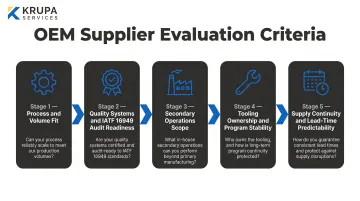
Process and Volume Fit
The first evaluation filter is process-to-part match: confirm whether the supplier's core process (stamping, casting, machining, forging, powder metallurgy) supports the required geometry, material, and production scale of your program. A stamping house can produce a simple bracket at 50,000 units/month efficiently; ask that same supplier to deliver a complex machined housing with ±0.005" tolerances and you'll encounter scrap, rework, and cycle time issues as volumes ramp. Process mismatches drive hidden costs that dwarf quoted piece price differences.
Quality Systems and Audit Readiness
IATF 16949:2016 defines quality management system requirements across the global automotive industry (AIAG). Magna's quality page confirms that "without IATF 16949 certification, a company is virtually ineligible as a supplier for serial production in the automotive industry." IATF 16949 and ISO 9001 certification indicate structured quality controls and documented process discipline—but OEMs should also verify how suppliers maintain dimensional consistency as production scales, not just at PPAP stage.
Secondary Operations and Part Completion Scope
Suppliers offering in-house secondary operations—heat treatment, machining, sub-assembly, coating—reduce multi-vendor coordination risk and scheduling exposure. For high-volume programs with tight delivery windows, consolidating secondary operations under one roof eliminates handoffs, reduces lead time variability, and simplifies root cause analysis when quality issues arise.
Tooling Ownership and Program Stability
OEMs benefit when suppliers control tooling design, maintenance, and storage. Tooling-driven processes (stamping, casting, forging) support geometric repeatability across multi-year programs without relying on ongoing machining adjustments. Verify who owns the tooling, where it's stored, and what the supplier's tooling maintenance schedule looks like—these details determine whether dimensions hold at unit 100,000.
Supply Continuity and Lead-Time Predictability
Reliable suppliers demonstrate predictable capacity planning, inventory visibility, and scheduling discipline. A survey found that 45% of automotive supply chain professionals identified disruption, parts shortages, and inventory management as their leading challenge (Automotive Logistics). When vetting suppliers, go beyond sample quality—ask for delivery data from long-run programs:
- On-time delivery rate across 12+ month production runs
- Documented capacity buffer for demand spikes
- Inventory visibility tools or reporting cadence
- References from programs with similar volume and complexity
Navigating this evaluation across dozens of potential suppliers is resource-intensive. Krupa Services works with OEM procurement teams to manage supplier qualification across a network of 100+ vetted manufacturers, combining OEM sourcing experience with Best Cost Country sourcing strategies to target 9–15% annualized cost savings through optimized supplier selection and performance management.
Conclusion
The right automotive parts manufacturing partner for an OEM is defined by process fit, operational consistency, and scalability across a program's full life—not by brand size or initial quoted price. Supplier selection shapes cost-per-part across program lifecycles measured in years and hundreds of thousands of units. That makes upfront qualification the highest-leverage work a procurement team does.
Before finalizing supplier decisions, sourcing teams should evaluate:
- Ongoing performance history and corrective action responsiveness
- Tooling ownership terms and end-of-program asset disposition
- Secondary operation scope and in-house vs. subcontracted capabilities
- Tier classification and sub-tier supply chain visibility
Revisit supplier fit as vehicle program volumes and specifications evolve. EV program delays, impairment charges at electrification-focused suppliers, and 23% revenue growth in e-propulsion segments are a reminder that aggregate metrics obscure segment-level risks during technology transitions.
Krupa Services works with OEMs and procurement teams on the qualification and sourcing work that directly affects cost and risk outcomes—PPAP approvals, supplier audits, program management, and global sourcing coordination across automotive and industrial programs. Contact Krupa Services at support@krupa-services.com or +1 720-984-0932 to discuss your next vehicle program.
Frequently Asked Questions
What is tier 1 and tier 2 and tier 3 automotive?
Tier 1 suppliers deliver complete systems or modules directly to OEM assembly lines under direct contract with automakers (e.g., seat assemblies, transmission systems). Tier 2 suppliers produce sub-components for Tier 1 suppliers (e.g., stamped seat rails, sensor modules). Tier 3 suppliers provide raw materials or standard parts to Tier 2 suppliers (e.g., steel sheet, fasteners, plastic resin).
Which is best, OEM or Tier 1?
OEMs design and assemble the final vehicle; Tier 1 suppliers engineer and supply the complete systems that go into it. These are distinct roles, not competing options. OEMs rely on Tier 1 suppliers for system-level manufacturing accountability, integration engineering, and sub-supplier management.
What companies make auto parts in the US?
U.S.-operating manufacturers span electronics, drivetrain, body systems, and more. Examples include Magna International (body/chassis systems), BorgWarner (turbochargers/e-drives), Dana Incorporated (axles/driveshafts), Aptiv (electrical architecture), Lear Corporation (seating/wiring), and Cummins (engines). The U.S. auto parts supply base includes hundreds of specialized manufacturers across Tier 1, 2, and 3 classifications.
Who is the world's largest supplier of automotive components?
Robert Bosch GmbH is the world's largest automotive parts supplier by original equipment revenue, with $54.4 billion in 2024 global OE sales (Automotive News 2025 Top Suppliers). Bosch dominates categories including fuel injection systems, braking systems, sensors, and ADAS components. Denso Corporation ranks second at $47.9 billion, followed by Magna International at $42.8 billion.
What are the top auto parts brands?
For OEM sourcing decisions, distinguish between OEM supply brands (Bosch, Magna, ZF, Denso, Aptiv, Continental, BorgWarner) and consumer-facing aftermarket brands (ACDelco, Motorcraft, Mopar, Duralast). In practice, procurement teams weight supplier process capability, IATF 16949 certification status, and audit readiness over brand recognition.