Key Takeaways
- Steel fabrication transforms raw steel through cutting, forming, welding, machining, and finishing
- Four steel types dominate fabrication: carbon (versatile, cost-effective), stainless (corrosion-resistant), alloy (high-strength), and tool steel (extreme hardness)
- Key industries: construction (52% of global steel use), automotive, renewable energy, mining, and oil & gas
- Modern fabricators use automated cutting and robotic welding for 3-4x productivity gains
- Choose fabrication partners with integrated capabilities, ISO or industry-relevant certifications, and a proven track record in your sector
What Is Steel Fabrication?
Steel fabrication is the process of transforming unfabricated steel products—such as sheets, plates, bars, and hollow structural sections—into finished components or assemblies through cutting, bending, welding, machining, and surface treatment. According to the American Institute of Steel Construction (AISC), this process is governed by strict quality standards and takes approximately 1.08 metric tonnes of mill-produced steel to create one metric tonne of fabricated structural steel, with the difference returned as manufacturing scrap.
Steel Fabrication vs. Steel Manufacturing
Steel manufacturing produces raw steel from iron ore or scrap metal—an upstream, mass-production process. Steel fabrication takes that raw material and customizes it into specific end-use products: a downstream process focused on precision and specification. Steel manufacturing makes the flour; fabrication bakes the bread.
Skilled fabricators—often called fab shops—work from engineering drawings, CAD files, or 3D models using a combination of manual expertise and automated CNC equipment. Quality is measured against exact specifications, with tolerances often held to +/-0.005 inches or tighter for critical applications.
Every fabricated component is specification-driven—fabricators don't guess; they build to blueprints. Common outputs include:
- Structural beams and equipment frames
- Vehicle chassis components and subassemblies
- Wind turbine towers and solar mounting structures
- Mining equipment parts and crusher components
- Precision machine assemblies for industrial machinery
Industry Scale
AISC represents approximately 1,000 fabricator members accounting for roughly 75% of total U.S. fabrication tonnage. Globally, the structural steel market was valued at $123.37 billion in 2025 and is projected to reach $202.06 billion by 2033, growing at 6.7% annually.
Types of Steel Used in Fabrication
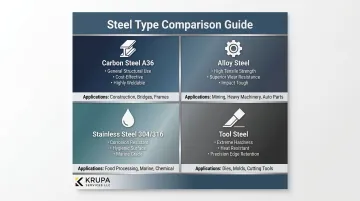
Selecting the right steel grade directly impacts strength, corrosion resistance, machinability, and total project cost. Here are the four primary steel types used in fabrication:
Carbon Steel (Low, Medium, High)
The workhorse of fabrication, carbon steel accounts for 90% of global steel production. ASTM A36 (low-carbon, 36 ksi yield strength) is the most widely used grade for its weldability, machinability, and cost-effectiveness.
For heavy-duty structural work, ASTM A572 Grade 50 delivers 50 ksi yield strength with improved corrosion resistance. High-carbon steel is harder and more brittle — best suited for wear resistance rather than formability.
Alloy Steel
Enhanced with elements like chromium, nickel, vanadium, or molybdenum, alloy steels deliver superior strength and wear resistance. These grades are preferred for heavy-duty industrial applications, mining equipment, and environments where standard carbon steel won't hold up.
Stainless Steel
Containing at least 10.5% chromium, stainless steel forms a self-healing oxide layer that resists corrosion. Common grades include 304 (general-purpose) and 316 (marine and chemical processing). Food processing, medical equipment, and moisture-exposed applications all depend on stainless for long-term reliability.
Tool Steel
Infused with tungsten, molybdenum, and other hardening elements, tool steel offers extreme hardness and heat resistance. Dies, molds, cutting tools, and precision components requiring minimal deformation under stress are its primary applications.
Choosing the Right Steel
The best choice depends on mechanical demands, environmental exposure, and budget. A quick reference:
- A36 carbon steel — general structural fabrication, cost-sensitive projects
- Alloy steel — high-stress mining, industrial machinery, heavy equipment
- Stainless (304/316) — corrosive environments, food processing, marine applications
- Tool steel — dies, molds, cutting tools requiring extreme hardness
Involve your fabricator in material selection early. The grade chosen affects cutting methods, welding procedures, and finishing requirements — changes made late in the process add cost and delay.
The Steel Fabrication Process: Step by Step
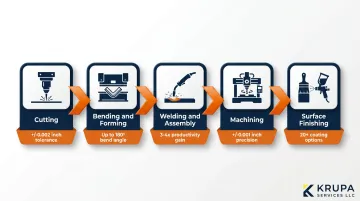
Most steel fabrication projects follow a defined sequence, though complexity and fabricator capabilities may vary. Here's the standard workflow:
Cutting
Cutting is typically the first physical step—reducing raw steel stock to required dimensions. Modern fabricators use several methods:
- Laser cutting: High-powered fiber lasers (20-50+ kW) deliver precision cuts with +/-0.002" tolerance. According to The Fabricator, lasers cut 2-inch steel plate at approximately 40 inches per minute—48% faster than plasma—with a straight kerf and no taper
- Plasma cutting: Best for thick plate and simple shapes; handles conductive metals well but produces slight edge taper
- Water jet cutting: Ideal for heat-sensitive materials or complex geometries requiring zero heat-affected zone
- Saw cutting: Efficient for straight cuts through thick sections and bar stock
CNC-controlled cutting minimizes material waste and ensures consistency across production runs.
Bending and Forming
Once cut, pieces are shaped into angles, curves, or profiles without removing material. Key methods include:
- Hydraulic press brake forming: Creates precision bends in sheets and plates; realistic tolerances are +/-0.010" to 0.020" linear and 1-2 degrees angular per industry benchmarks
- Roll bending: Produces curved and cylindrical shapes for tanks, vessels, and structural arches
- CNC bending machines: Delivers repeatable, tight-tolerance bends for brackets, frames, enclosures, and structural members
Tip for engineers: Material thickness variations of +/-0.006 inches (common for 10-gauge A36) can produce 4+ degrees of angular variation. Design around realistic material tolerances to reduce scrap rates.
Welding and Assembly
Formed components are then welded or assembled into finished structures. Welding fuses steel pieces using heat and filler material. Common methods:
- MIG (GMAW): fast, high-production welding for structural steel and general fabrication
- TIG (GTAW): precision welding for thin materials, stainless steel, and critical joints
- Stick (SMAW): portable, works outdoors and in adverse conditions
- Robotic welding: achieves 60-80% arc-on time versus 15-25% for manual welding, a 3-4x productivity improvement
Assembly also includes bolting, riveting, and mechanical fastening for components requiring disassembly or field adjustment. All structural welding follows AWS D1.1/D1.1M:2025 standards.
Machining
Where assembly alone can't hit final specifications, CNC machining refines fabricated components through material removal: milling, turning, drilling, or grinding. Standard CNC machining holds +/-0.005" tolerances; precision work achieves +/-0.001" or tighter for aerospace and medical applications.
Machining is critical for components with tight tolerances, such as transmission shafts, adapter fittings, and mounting interfaces. Krupa Services integrates CNC machining into a full-service fabrication workflow, so components move from laser cutting or press brake forming directly to machining within a single production environment, reducing lead times and coordination overhead.
Surface Finishing
The final step protects components and enhances appearance:
- Hot-dip galvanizing: Zinc coating provides 72-73 years of maintenance-free service even in industrial atmospheres (American Galvanizers Association)
- Powder coating: Durable, decorative finish with excellent corrosion resistance
- Electroplating: Applies a thin metal layer (zinc, chromium, nickel) via electrochemical process
- Painting: Barrier protection and aesthetic options for indoor and outdoor use
The right finish extends component life and reduces lifecycle costs, especially for outdoor, marine, or high-humidity environments.
Key Industries That Rely on Steel Fabrication
Steel fabrication underpins nearly every industrial sector. The World Steel Association reports construction accounts for 52% of global steel use, with automotive at 12%. Here are six industries and how they depend on fabricated steel:
- Construction & Infrastructure: Structural beams, columns, trusses, bridges, and building frameworks; steel-framed buildings are 4-8 times lighter than concrete equivalents
- Automotive & Transportation: Vehicle frames, chassis components, drivetrain assemblies; modern vehicle steel reaches 1,900 MPa tensile strength—10x stronger than 50 years ago
- Renewable Energy: Wind turbine towers (a 4 MW turbine requires 300-600 tonnes of steel), solar panel mounting systems, hydroelectric structures
- Oil & Gas: Pipelines, drilling platforms, refinery structures, field equipment designed for harsh environments
- Mining & Industrial Machinery: Crusher components, conveyor systems, material handling equipment, heavy-duty frames
- Aerospace & Defense: Aircraft support structures, ground support equipment, precision components with tight tolerances
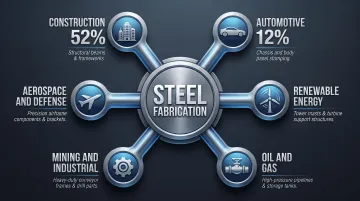
Each industry sets its own bar. Aerospace requires certified tolerances measured in thousandths of an inch. Mining demands wear-resistant alloys that hold up under continuous impact. Renewable energy projects involve large-scale structural assemblies built for decades of outdoor exposure. A fabrication partner without direct experience in your sector is starting from scratch — and that gap shows up in rework costs, missed specs, and delayed timelines.
Benefits of Steel Fabrication
Strength and Durability
Steel can be 1,000 times stronger than iron, with modern grades reaching 1,900 MPa tensile strength. Properly fabricated and finished steel structures routinely exceed 100 years of service life. Advanced high-strength steels reduce weight by 25-40% while maintaining structural integrity.
Design Flexibility and Customization
Fabrication supports near-unlimited shape complexity, letting engineers design for function rather than material limitations. The result: optimized structures that balance strength, weight, and cost across demanding industrial applications.
Cost Efficiency and Speed
According to AISC data, fabrication and erection represent approximately 70% of a steel package's cost, while raw material is less than one-third. This means innovative fabrication technology and modeling can reduce total package cost by 10-20%.
The Rainier Square project illustrates steel's speed advantage: steel erection was 40% faster than alternatives, saving 10 months of construction schedule—and 10 additional months of revenue for the building owner.
Sustainability and Recyclability
Beyond cost and speed, steel delivers a strong environmental case. It is 100% recyclable without quality loss, and new steel products average 30% recycled content. In 2021 alone, 680 million tonnes of steel were recycled, avoiding over 1 billion tonnes of CO₂. Steel-framed buildings often carry positive salvage value at end of life—turning demolition into a recoverable asset.
How to Choose the Right Steel Fabrication Partner
Selecting a fabrication partner requires evaluating three core areas:
In-House Capabilities
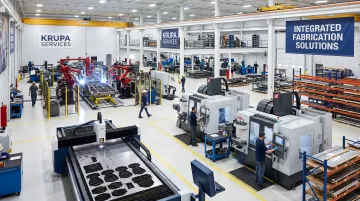
Look for fabricators offering cutting, forming, welding, machining, and finishing under one roof. Integrated capabilities reduce lead times, minimize coordination friction, and improve quality control. A partner who must outsource machining or coating adds handoff points where errors and delays accumulate.
Quality Standards and Certifications
AISC certification is address-specific and category-based. Key categories include Building Fabricator (BU), Bridge Fabricator (SBR/IBR/ABR), and Hydraulic Fabricator (HYDS/HYDA). Additional certifications to look for: ISO 9001 (quality management), AWS D1.1 qualification (welding procedures), and industry-specific standards like AS9100 (aerospace).
Industry Experience and Sourcing Network
A partner familiar with your sector's tolerances and regulatory requirements delivers better outcomes. For projects requiring specific steel grades or international sourcing, a robust supplier network becomes critical.
Krupa Services, for example, covers laser cutting, hydraulic press brake forming, CNC machining, and welding assembly in-house, backed by a network of 100+ vetted manufacturers. Their Best Cost Country (BCC) sourcing model gives buyers across automotive, construction, renewable energy, and mining access to competitive pricing without sacrificing lead times or quality.
Communication, Lead Times, and Flexibility
Beyond technical capability, how a partner communicates often determines whether a project stays on track. Before committing, ask:
- What are standard lead times for your component type and volume?
- How does the fabricator manage capacity during peak demand periods?
- Do they offer design-phase technical support (DFM review, material substitution guidance)?
Partners who answer these questions directly — and in writing — are usually the ones who deliver.
Frequently Asked Questions
How much does it cost to fabricate steel?
Steel fabrication costs vary based on material grade, part complexity, required processes, volume, and finishing. According to AISC, fabrication and erection represent approximately 70% of a steel package's total cost, while raw material is less than one-third. Request custom quotes that specify material, tolerances, finishing, and delivery requirements for accurate pricing.
What are the three types of metal fabrication?
The three primary categories are: cutting (reducing raw material to size and shape using laser, plasma, or saw), forming/bending (shaping material without removing it through press brakes or roll bending), and assembly/welding (joining components into a final structure through welding, bolting, or fastening).
Which steel is best for fabrication?
It depends on the application. Carbon steel (A36) is the most versatile and cost-effective choice for general structural use. Stainless steel suits corrosion-sensitive environments (food processing, marine, chemical), while alloy steel is preferred for high-stress applications like mining and industrial machinery.
What is structural steel fabrication?
Structural steel fabrication produces load-bearing components (beams, columns, trusses, and frames) used in buildings, bridges, and large infrastructure. It follows strict engineering standards like AISC's Code of Standard Practice (ANSI/AISC 303-22) and requires precise geometric control to ensure structural integrity and safety.
What is considered custom fabrication?
Custom fabrication produces steel components built to a client's specific design or engineering drawing, rather than standard off-the-shelf shapes. It tailors dimensions, materials, tolerances, and processes to unique project requirements, covering everything from one-off prototypes to specialized production runs.
What do heavy fabricators do?
Heavy fabricators specialize in large-scale, high-tonnage structures such as pressure vessels, structural frameworks, mining equipment, and industrial machinery. The work demands heavy-duty equipment, specialized welding procedures, and certified machinists and welders qualified for critical applications.
Ready to start your next steel fabrication project? Krupa Services works with industrial buyers across automotive, construction, mining, and renewable energy sectors to source and manufacture precision steel components — from laser cutting and press brake forming to CNC machining and welding assembly. Contact our technical team at support@krupa-services.com or call +1 720-984-0932 to discuss your project requirements.