This decision affects your wallet, vehicle performance, warranty coverage, and long-term reliability. For newer vehicles under warranty, choosing the wrong part type can create compliance headaches. For older vehicles, overpaying for OEM parts when quality aftermarket alternatives exist means wasting money. This guide breaks down the technical, financial, and practical differences so you can choose the right parts for your specific situation.
Key Takeaways
- OEM parts are manufactured by or for your vehicle's original maker; aftermarket parts are made by independent third-party companies
- Aftermarket parts typically cost 20–50% less than OEM; OEM parts guarantee exact fitment and factory-level quality
- OEM is the strongest choice for vehicles under warranty, leased cars, and complex electronic components like sensors or ECUs
- Aftermarket is a smart fit for older vehicles, routine maintenance items, and performance upgrades—provided you source from certified, reputable suppliers
- The right choice depends on vehicle age, part type, and supplier quality—sticker price alone rarely tells the full story
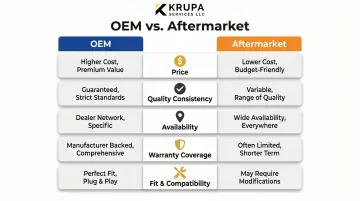
OEM vs. Aftermarket Parts: Quick Comparison
OEM vs. Aftermarket Parts: Quick Comparison
Price
OEM parts carry a 50–60% price premium over aftermarket alternatives, according to industry data. That markup reflects controlled manufacturing, guaranteed compatibility, and warranty coverage — not just the brand name.
Aftermarket parts run 20–50% less on average. Price varies by tier: premium aftermarket brands can match OEM quality at a lower cost, while budget options maximize savings with more variable reliability.
Quality Consistency
OEM parts are guaranteed to meet exact factory specifications — same tolerances, same materials, same engineering blueprints. Quality is consistent across every unit.
Aftermarket quality varies by manufacturer. Premium brands with CAPA (Certified Automotive Parts Association) certification can match or exceed OEM standards through independent testing. Budget brands may use lower-grade materials or looser tolerances.
Availability
| OEM | Aftermarket | |
|---|---|---|
| Where to buy | Authorized dealerships only | Auto parts stores, online retailers, independent shops |
| Lead times | Longer for discontinued or low-volume parts | Faster in most markets |
| Supply risk | Single-source chain can cause backorders | Multiple manufacturers reduce shortage risk |
Warranty Coverage
OEM warranties are generally solid: Toyota covers 12 months, GM's ACDelco Gold line offers 24 months/unlimited miles, and Ford accessories run 24 months/unlimited mileage. Dealer-installed parts often include labor coverage too.
Aftermarket warranties vary by brand. Premium manufacturers may offer one year; budget brands often provide 90 days or nothing at all. Always confirm warranty terms before purchasing — especially for commercial applications.
Fit and Compatibility
OEM parts are engineered for your specific make, model, and year — exact fitment is guaranteed down to bolt patterns, mounting points, and dimensional tolerances.
Aftermarket parts use universal specifications designed to fit multiple vehicle models. Most install without issues, though minor adjustments are occasionally needed for mounting brackets, wiring harnesses, or sensor placements.
Understanding these trade-offs across price, quality, availability, warranty, and fit sets the foundation for making the right call for your specific situation.
What Are OEM Car Parts?
Original Equipment Manufacturer (OEM) parts are components produced by the same company that built your vehicle, or by suppliers contracted directly by your automaker. These parts are identical in design, materials, and specifications to what came installed at the factory.
When you replace a worn brake rotor with an OEM rotor, you're installing the exact same component that was bolted to your vehicle on the assembly line.
Every dimension, material composition, and tolerance matches the original engineering blueprints. For complex assemblies — transmission components, engine control units, or ADAS sensors — that exact match prevents compatibility issues, calibration errors, and performance degradation.
Core advantages include:
- Fits without modifications or adjustments — no guesswork at installation
- Meets automaker specifications through controlled manufacturing processes
- Typically includes 12–24 month coverage and won't jeopardize your existing vehicle warranty
- Eliminates research burden: one correct part exists for each application
Use Cases of OEM Parts
OEM parts are the strongest choice when precision, warranty compliance, and long-term reliability take priority over upfront cost:
- Vehicles under manufacturer warranty — non-OEM parts on critical systems can complicate claims if a failure occurs
- Leased vehicles — lease agreements often require OEM parts to maintain residual value standards
- Collision and structural repairs — insurance policies and safety regulations frequently mandate OEM parts to restore original crash performance and dimensional accuracy
- High-tech electronic components — sensors, ECUs, ADAS cameras, and powertrain computers require exact programming compatibility that aftermarket alternatives may not guarantee
What Are Aftermarket Car Parts?
Aftermarket parts are components manufactured by third-party companies independent of the original vehicle manufacturer. They're designed to perform the same function as OEM parts, typically by reverse-engineering factory components to replicate specifications and identify improvement opportunities.
The aftermarket space is vast and highly variable — ranging from well-established brands with rigorous quality standards to budget suppliers prioritizing low cost over durability. Premium manufacturers earn CAPA certification by meeting ASTM and SAE testing protocols covering dimensional accuracy, material performance, and vehicle fit. Uncertified parts, on the other hand, may use inferior materials or inconsistent manufacturing processes.
Core advantages include:
- Lower price point – Typically 20–50% less than OEM due to competitive market forces
- Wider availability – Multiple manufacturers and distribution channels reduce lead times
- Broader selection – Some categories offer performance upgrades not available from OEM catalogs
- Performance potential – In brake pads, exhaust systems, and filters, top-tier aftermarket options can outperform OEM specifications
Use Cases of Aftermarket Parts
Aftermarket parts deliver the best value when cost-effectiveness, availability, and performance customization matter more than exact OEM replication:
- Older vehicles out of warranty — once manufacturer coverage expires, aftermarket parts reduce maintenance costs without compromising reliability
- High-mileage vehicles where total cost of ownership matters more than a perfect factory match
- Routine maintenance items — oil filters, air filters, brake pads, belts, and wiper blades where certified aftermarket parts perform comparably to OEM
- Performance upgrades — enthusiasts seeking improved braking, handling, or power output often find better options in the performance aftermarket
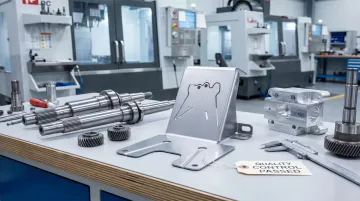
For fleet operators and procurement teams sourcing at scale, the quality gap between certified and uncertified aftermarket narrows considerably when working with manufacturers that apply formal qualification processes. Krupa Services, for example, combines CNC machining, stamping, and fabrication capabilities with a 100+ vetted supplier network and PPAP approval processes — providing quality-verified sourcing for components like transmission shafts, stamped brackets, and precision-machined assemblies as a direct alternative to dealership channels.
OEM vs. Aftermarket: Which Should You Choose?
The right choice depends entirely on your situation. Evaluate these factors before deciding:
Key decision factors:
- Vehicle age and warranty status
- The specific part being replaced
- Budget constraints and total cost of ownership
- Availability and lead time urgency
- Performance goals and customization needs
Total Cost of Ownership vs. Sticker Price
Aftermarket parts win on upfront cost, but the full cost picture often favors OEM. Poor fitment or premature failure from low-quality parts can trigger costly follow-up repairs that erase any initial savings.
For example, AAA research shows that minor collisions on vehicles with Advanced Driver Assistance Systems can cost up to $5,300 to repair—almost 2.5 times higher than non-ADAS vehicles—due to expensive OEM sensors and mandatory calibration procedures.
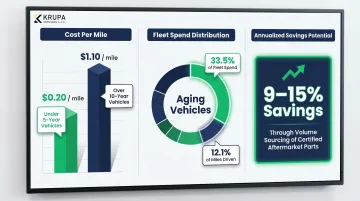
For fleet operators, the math shifts with vehicle age. Fleetio benchmark data shows vehicles over 10 years old consume roughly 33.5% of total service spend despite accounting for just 12.1% of miles driven. Service costs average $0.20 per mile for vehicles under five years, versus $1.10 per mile for vehicles over 10 years.
In these high-cost aging vehicle scenarios, quality aftermarket parts can deliver measurable savings without sacrificing reliability.
Quality Assurance for Aftermarket Parts
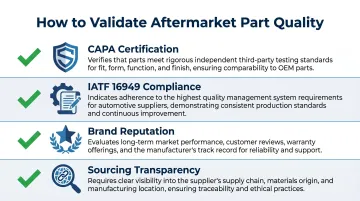
Not all aftermarket parts are created equal. Buyers can validate quality through certification and sourcing transparency:
- CAPA certification – For collision parts, CAPA Quality Seal confirms the part passed dimensional accuracy, adhesive integrity, and vehicle test fit requirements
- IATF 16949 compliance – Suppliers certified to this automotive quality management standard meet rigorous process controls aligned with ISO 9001
- Brand reputation – Established aftermarket brands with decades of market presence typically maintain consistent quality
- Sourcing transparency – Reputable suppliers provide traceable manufacturing documentation and testing results
Warranty and Insurance Implications
Under the U.S. Magnuson-Moss Warranty Act, manufacturers cannot void your vehicle warranty simply because you used aftermarket parts. Automakers can only deny warranty coverage if they prove the aftermarket part caused the specific failure. The FTC actively enforces this protection—in 2022, it issued final orders against Harley-Davidson and Weber for illegally claiming warranties would be voided if third-party parts were used.
That said, if an aftermarket part causes damage to surrounding components, that specific damage may not be covered. For vehicles still under manufacturer warranty, document every aftermarket installation and keep receipts to protect your rights.
Insurance policies vary in their stance on aftermarket parts. State Farm's estimates may include non-OEM parts but recognize CAPA and NSF certifications. Allstate allows customers to request OEM parts but may require paying the cost difference between the adjuster's estimate and OEM pricing.
Resale Value Considerations
OEM parts generally preserve resale and trade-in value better than uncertified aftermarket alternatives. According to Kelley Blue Book, excessive aftermarket modifications can narrow the buyer pool and reduce overall value. Edmunds doesn't provide True Market Value pricing for vehicles with aftermarket parts, citing wide quality variation. Dealers frequently reduce trade-in offers to cover the cost of returning modified vehicles to stock condition.
Real-World Scenarios: When Each Part Type Makes Sense
Scenario 1: Post-Collision Repair on a Leased Vehicle
For leased vehicles, OEM parts are the only practical option for collision repairs. Lease agreements, insurance requirements, and structural precision standards leave little room for substitution. Using aftermarket parts creates real exposure:
- Lease-end penalties for non-OEM repairs that reduce residual value
- Insurance adjusters may flag non-certified repairs
- Structural components must restore original crash performance characteristics
The cost premium for OEM parts (50–60% higher) is unavoidable in this scenario, but it protects against lease-end disputes and maintains the vehicle's certified safety integrity.
Scenario 2: Fleet Operator Maintaining Older Commercial Vehicles
The calculus shifts entirely when you're managing a fleet of aging commercial vehicles. Once vehicles are out of warranty, quality aftermarket parts from certified manufacturers become the smarter financial and operational choice:
- Lower per-unit costs reduce total cost of ownership as maintenance expenses climb with age
- Faster procurement through diversified supplier networks cuts procurement lead times and keeps vehicles on the road
- Volume purchasing from vetted manufacturers can yield 9–15% annualized savings
For businesses sourcing at scale, working with a supplier that offers Best Cost Country (BCC) sourcing expertise and a vetted manufacturer network — like Krupa Services — can translate those percentage savings into real budget impact without sacrificing delivery reliability.
Scenario 3: Performance Enthusiast Upgrading Brake Pads or Exhaust
Performance upgrades are where aftermarket parts don't just compete with OEM — they routinely beat it. Components in these categories are engineered specifically to exceed factory specs:
- High-performance brake pads offer improved heat dissipation and shorter stopping distances under aggressive driving
- Performance exhaust systems can increase horsepower and improve throttle response
- Upgraded suspension components provide better handling dynamics than comfort-focused OEM parts
This is the rare scenario where aftermarket is not just acceptable but actively preferred. Premium performance brands engineer components specifically to exceed factory performance metrics, making them the superior technical choice for enthusiasts.
Conclusion
The right part for your vehicle comes down to context, not brand loyalty. OEM parts deliver guaranteed fitment, factory-level quality, and warranty protection — making them the go-to choice for newer vehicles, leased cars, and complex electronic systems. Quality aftermarket parts are well-suited to older vehicles, routine maintenance, and performance upgrades, provided you source from reputable, certified manufacturers.
Ultimately, the label matters far less than the source behind it. What to prioritize depends on who's doing the buying:
- Individual owners: Verify certifications like CAPA and research the manufacturer's track record before purchasing.
- Businesses and fleet operators: Partner with precision manufacturing suppliers that offer traceable sourcing, documented quality validation, and consistent delivery reliability.
Getting this decision right protects both your vehicles and your bottom line.
Frequently Asked Questions
How do OEM parts compare to aftermarket auto parts?
OEM parts are manufactured to exact factory specifications by or for the original automaker, ensuring guaranteed fitment and consistent quality. Aftermarket parts come from independent third parties and vary widely — premium certified brands can match OEM performance, while budget options may compromise on materials or tolerances.
Which is usually less expensive: OEM or aftermarket auto parts?
Aftermarket parts are generally 20–50% cheaper than OEM due to competitive market forces and diverse manufacturing sources. Price alone shouldn't drive your decision, though — quality varies dramatically across brands, and the cheapest option often costs more long-term if it fails early or requires rework.
Do aftermarket parts void my car's warranty?
Under the U.S. Magnuson-Moss Warranty Act, manufacturers cannot void your warranty simply because you used aftermarket parts. They can only deny coverage if they prove the aftermarket part caused the specific failure. Document all installations and keep receipts to protect your warranty rights.
Are aftermarket car parts safe to use?
Aftermarket parts from certified manufacturers with verifiable quality controls are safe and reliable. Look for certifications like CAPA for collision components or IATF 16949 for quality management. Avoid unverified budget brands for safety-critical components like brakes, suspension, or airbag systems.
When should I always use OEM parts instead of aftermarket?
OEM is the strongest choice in these situations:
- Vehicles still under manufacturer warranty or lease agreements
- Post-collision structural repairs requiring dimensional precision
- Complex electronics like ADAS sensors or ECUs needing exact calibration
How do I ensure I'm buying quality aftermarket car parts?
Follow these steps before purchasing:
- Verify certifications like CAPA or NSF for your specific part type
- Confirm the supplier provides transparent sourcing documentation
- Use VIN-based compatibility tools to check exact fitment
- Avoid parts lacking manufacturer identification or traceable quality controls